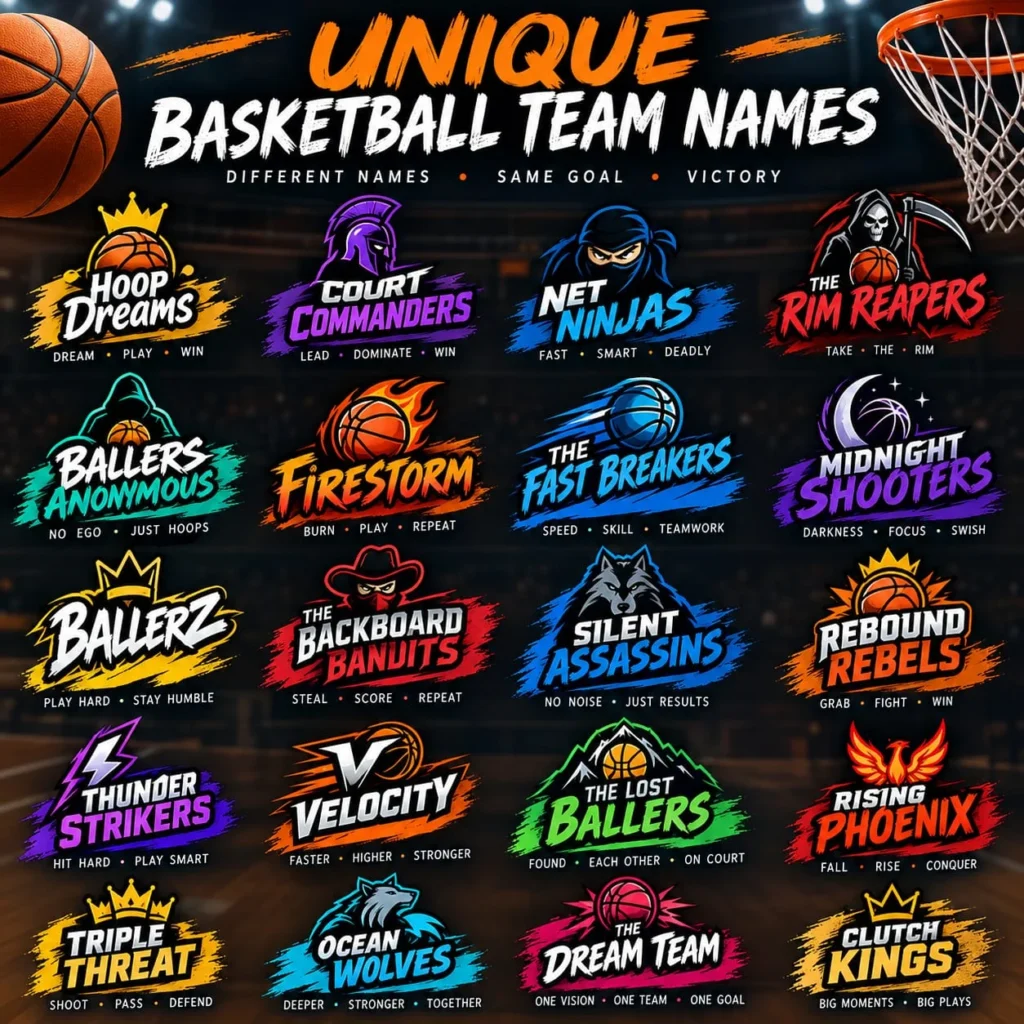
Unique names for a basketball team come from specifics only your team has: your trade, your street, your shared story, or your worst play. Below are five sources of uniqueness borrowed from NBA naming history, 30-plus original examples, and a quick way to check that no other team in your league has the same name.
Two meanings of “unique”
People searching this keyword usually want one of two things, and they need different tactics:
- Unusual: a name that sounds different from the usual Eagles, Warriors, and Thunder.
- Unduplicated: a name no other team in your league, bracket, or town is using.
Strange isn’t automatically unique. A random string of words can still collide with another team’s, and a perfectly normal name can be unique if it comes from something specific to you. The sources below aim for both.
Five sources of uniqueness, from NBA history
1. Your trade or employer
The Detroit Pistons trace back to the Zollner Pistons of Fort Wayne, Indiana, named for the pistons that owner Fred Zollner’s company manufactured. When the team moved to Detroit in 1957, Zollner dropped his own name but kept Pistons. If your team is made up of electricians, teachers, nurses, or developers, the equivalent is a name from your shared work.
2. The pop culture of the moment
The Toronto Raptors were one of ten finalists in a fan-naming contest, and Jurassic Park had been a big hit the year before. Grantland praised the result as “short, punchy, ludicrous,” and noted it beat more regional names like Huskies and Terriers. The lesson: a name of the moment can be memorable, though it will date quickly.
3. Rhyme with the neighbors
The New York Nets got their name partly because it rhymed with the Jets and Mets, two other New York teams. A name that echoes a local team or school gives you a built-in connection.
4. An unexpected animal or object
Pick something no one else would, with a loose link to the game. Jumping Spiders suggest leaping, and Mantis Shrimp suggest a surprising punch.
5. A contest with finalists
Many NBA names came from public contests. The Mavericks, for instance, were chosen by owner Donald Carter from finalists suggested by a Dallas radio station, ahead of Wranglers and Express. Washington’s renaming from Bullets to Wizards in 1997 came from a contest whose finalists, per one source, were Dragons, Express, Stallions, Sea Dogs, and Wizards. You can run the same process within your team.
Names by source
From your trade
- Short Circuits (electricians)
- Pipe Dreams (plumbers)
- Merge Conflicts (developers)
- Sidebar Society (lawyers)
- Balance Sheet Ballers (accountants)
- Pop Quiz Posse (teachers)
- Rising Dough (bakers)
- Help Desk Defense (IT teams)
- Traveling Salesmen (sales teams, a pun on the travel violation)
- Pivot Table (office teams, since pivoting is also a basketball move)
From basketball terms, in unusual ways
- Technical Difficulties
- Screen Time
- Swishful Thinking
- Double Dribble Trouble
- Shot Clock Watchers
From odd animals
- Axolotls
- Pangolins
- Mantis Shrimp
- Narwhals
- Jumping Spiders
- Capybaras
From invented words
- Hoopocalypse
- Jump Ball Jubilee
From your own story
Think of the funniest true thing that has happened to your group, such as a flooded gym, a lost bus, or a missed buzzer-beater, and name the team after it. Nobody else has your story, so the name can’t be a duplicate.
Source comparison
| Source | Example | Strength | Risk |
|---|---|---|---|
| Trade or employer | Short Circuits | Personal and hard to duplicate | Only works for that group |
| Pop culture | Hoopocalypse | Instantly memorable | Dates quickly |
| Rhyme with locals | A name echoing a nearby team | Built-in local link | Needs local knowledge |
| Odd animal | Axolotls | Easy to draw as a logo | May be used by another team |
| Contest finalist | Chosen from a shortlist | Team buy-in | Needs a few days |
| Shared story | A name from your own joke | Truly unique | Outsiders won’t get it |
Check the connotations first
Washington’s team changed its name from Bullets to Wizards in 1997 to create a more positive image and move away from violent connotations. If your league includes kids, schools, or community groups, avoid names with weapon or violence associations, since organizers sometimes reject them and they can read badly on a shirt.
Check that it’s actually unique
- Ask your league organizer for the current team list. It’s the only way to be sure within your league.
- Search the name in quotes online and on social media, and check whether another local team or club uses it.
- Say it aloud. Strange spellings can be funny but are hard to announce and hard for people to find online.
- Look at nearby leagues, since players move between them.
- Check trademarks if you plan to sell merchandise. A name can be unused locally and still belong to a brand.
Choosing one
Collect up to ten names, cut anything that fails the checks above, and vote on the final five, the way the Wizards contest worked. Ask members for their top two, not just one, so you can find a name most people can live with.
FAQ
Is unique better than good?
Not always. A clear, strong name beats a clever one nobody remembers. The goal is a name that’s memorable and unlikely to duplicate, not strange for its own sake.
Should I invent a word?
It can work, but invented words are harder to say and search for. Test it aloud and see whether people repeat it correctly.
Can a common animal still be unique?
Yes, if you add something specific. A common animal tied to your street, school, or trade is unlikely to match another team exactly.
How do I run a name contest?
Collect ideas, narrow them to five or ten, and let everyone vote. That’s roughly how teams like the Raptors and the Mavericks were chosen from finalists.
What if another team shows up with the same name?
Ask the organizer, who may require one team to change. A small tweak, like adding your neighborhood, usually settles it.
Are odd spellings a good idea?
They can make a name distinctive, but they also make it hard to announce and search. Use them sparingly.
Conclusion
The most unique basketball team names come from specifics, such as your trade, your town, or your own story, not from unusual words picked at random. Borrow the Pistons’ trade-based approach, the Nets’ rhyming trick, or the Mavericks’ contest method, check connotations the way the Wizards did, and confirm with your league that no one else has the name. Skip anything you can’t say aloud or that could be read as violent.