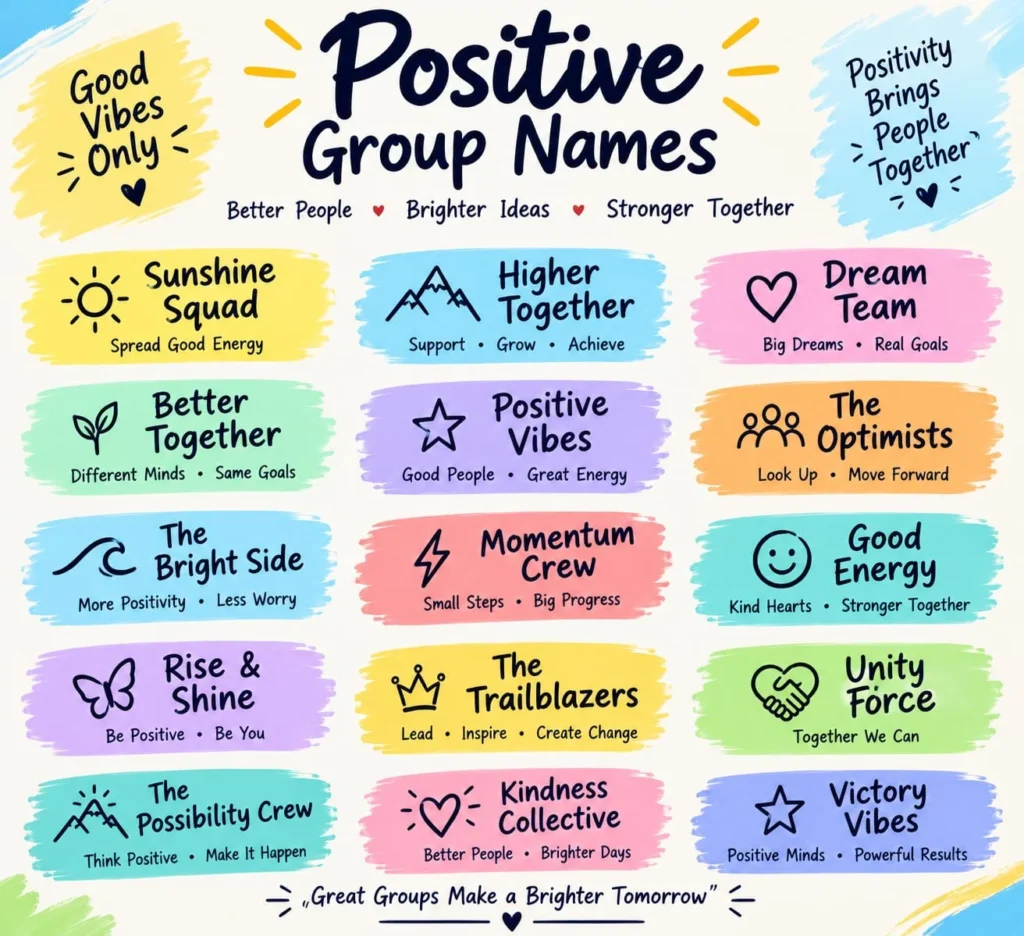
Positive names for groups work when they promise something members can actually do or feel, such as welcome, growth, kindness, or steadiness, instead of stacking up cheerful words. Below are names sorted by purpose, a quick test for hidden acronyms, and the situations where an upbeat name can backfire.
What “positive” really means in a name
A name can be positive in three different ways, and mixing them up is why many lists feel generic:
- Aspirational: it points toward something members hope for (Rising Together, First Light Group).
- Behavioral: it describes what the group does (Kindness Corps, Good Neighbors Network).
- Welcoming: it tells newcomers they belong (Table for Everyone, The Welcome Mat).
A name like “Positive Vibes” is positive but says nothing. The three types above give a prospective member a reason to show up.
What the existing advice leaves out
Most ranking pages pad the topic with adjectives and sample lists. The useful guidance I found is more specific:
- A church-leadership guide suggests using your group’s real activities, such as a fundraiser or service project, as the source for a name. It also says to keep separate names for separate age groups, involve the kids in the search, and avoid borrowing another organization’s slogan or a nearby group’s name.
- A youth-ministry writer warns that names like Rampage, Bomb Squad, and Mob don’t carry positive connotations, even when kids chose them. The same writer cautions that acronyms can backfire, giving the example of a group that landed on a name spelling out SPEW. The writer’s bottom line is that the program matters more than the name, so pick one that is simple and positive.
- A men’s-group facilitator says a name should make members comfortable, and recommends asking others for ideas.
Three practical additions this article covers: test names for accidental acronyms, match the tone to the group’s purpose, and check whether “positive” is actually right for the people you serve.
Names by purpose
Support and community groups
Gentle, steady names tend to work better here than loud ones.
- Common Ground
- Steady Steps
- Still Rising
- The Open Circle
- Anchor and Oak
- Lighthouse Circle
Youth and kids’ groups
- Brave Builders
- Little Sprouts
- Bright Sparks
- Helping Heroes
- Joy Brigade
Church and faith groups
Biblical concepts can be powerful, according to the church-leadership guide above, because they remind members why the group exists.
- Light Bearers
- Anchor Youth
- Open Door Fellowship
Workplace teams and committees
- Kudos Crew
- Bright Spot Team
- Wins Wednesday Crew
Service and volunteer groups
- Kindness Corps
- Helping Hands Brigade
- Good Neighbors Network
- Give Back Gang
Learning and hobby groups
- Curious Minds Collective
- Lifelong Learners League
- Stepping Stones
Resilience and wellness groups
- Grit and Grace
- Strong Together
- Bounce Back Club
- Fresh Start Fellowship
Matching name to purpose
| Group purpose | Name pattern | Example | Watch out for |
|---|---|---|---|
| Support | Calm noun + circle/ground | Common Ground | Cheery names can feel dismissive |
| Youth | Fun adjective + role | Brave Builders | Age-appropriate language matters |
| Faith | Concept from the tradition | Light Bearers | Avoid copying a nearby group |
| Work | Action + team word | Kudos Crew | Can sound forced if morale is low |
| Service | Behavior + crew | Kindness Corps | Overused “kindness” names |
| Learning | Curiosity + group word | Curious Minds Collective | Can be vague |
The acronym and initials test
Group names built from initials can spell something you didn’t intend, as the SPEW example shows. Before you commit:
- Write out the initials of the full name and read them aloud.
- Check shortened forms and nicknames that members might use.
- Ask someone outside the group to read it, since people close to the project often miss the obvious.
When upbeat backfires
Not every group wants a sunny name. A group dealing with grief, illness, or recovery may find “Positive Vibes Only” dismissive, because it implies hard feelings don’t belong. That’s my judgment, not a researched finding, and the men’s-group advice above supports the principle: choose something members are comfortable saying. Hopeful and steady, like Still Rising or Steady Steps, usually lands better than cheerful. For groups where members may want privacy, a name that doesn’t disclose the topic lets people mention the group without explaining it.
Why behavioral names tend to stick
A name that suggests an action invites people to join something, not just to feel something. Joining the Kindness Corps asks for kindness, and joining the Welcome Mat team makes you a person who welcomes. That shift from mood to role is what gives a name staying power. It’s also why the youth-ministry writer’s point holds: a name only supports the work. It can’t replace it.
Choosing one
- Start from what the group does or hopes to do.
- Draft five names across the three types (aspirational, behavioral, welcoming).
- Run the acronym test and read them aloud.
- Check whether another group nearby uses the same name.
- Ask members to vote. In youth groups especially, involving the kids is a good idea.
FAQ
Should a positive group name be funny or serious?
It depends on the group. Playful names suit kids’ clubs and workplace teams, while support and faith groups usually do better with something warmer and steadier. If you’re unsure, calm and welcoming is rarely wrong.
Can a group name be too positive?
Yes. Names that insist on constant cheer can feel false to a group working through something difficult. Hopeful, rather than relentlessly happy, tends to ring true.
How long should the name be?
Two to four words is enough for most groups. Short names are easier to say, print, and remember, and they fit on a sign-up sheet or group chat.
Should kids choose the name?
Often a good idea. The church-leadership guide recommends involving young people, since a name they helped pick keeps them invested.
How do I check whether a name is already taken?
Search your local area, social media, and any community directories for the same name. The church-leadership guide specifically warns against taking the name of another nearby group.
What if I want to use a word from another language?
Confirm its meaning with someone who speaks the language, and make sure borrowing it is appropriate. Words can carry different meanings or connotations than a translation suggests.
When should we rename the group?
When the mission changes or the name no longer fits who’s in the room. Renaming costs you recognition, so do it only when the old name genuinely stops working.
Conclusion
The strongest positive names for groups say what members will do or feel together: welcome, grow, help, steady. Pair a plain, warm word with a role or setting, check the initials for accidents, and skip names that sound tough or cheery for their own sake. For groups facing hard circumstances, aim for hopeful rather than bubbly. And remember the youth-ministry writer’s point: the name matters, but the group’s work matters more.