Understanding the Power of a Great Group Name
Choosing the right name for a student team is often the first real test of a group’s chemistry. In the world of science, where projects can range from grueling lab reports to high-stakes robotics competitions, a name is more than just a label. It is your team’s identity.
Many students search for these names because they want to break the ice and inject some personality into an otherwise dry academic environment. A well-chosen name shifts the mood from “stressed classmates” to “collaborative innovators,” instantly boosting morale before the real work begins.
This guide solves the common frustration of staring at a blank whiteboard for an hour. Instead of settling for generic monikers, we will explore how to craft a title that reflects your niche, humor, and collective intelligence.
Group Names for Science Students – Quick Meaning
A science group name is essentially a creative badge that combines scientific terminology with wit, pop culture, or ambition. It serves as a rallying cry, a way to stand out during presentations, or a fun way to identify your team in a crowded lab session.
- The Intellectual Approach: Focusing on chemistry puns or physics laws.
- The Humorous Approach: Using self-deprecating science jokes.
- The Professional Approach: Aiming for prestige and academic weight.
“A great name should feel like an inside joke that everyone in the department understands, but only your group truly owns.”
Why Names Matter in Lab Settings
When you walk into a lab, having a cohesive identity helps in coordinating tasks. It frames the way you view your challenges. If your group is called “The Catalyst Crew,” you are mentally framing yourselves as the agents of change in your experiments.
Origin & Background of Scientific Branding
The tradition of naming academic groups has evolved significantly alongside social media. In the past, students were often assigned “Group A” or “Lab Station 4.” Today, students crave personal branding even in their extracurriculars.
The rise of platforms like Instagram and Discord has turned academic project groups into miniature online communities. Students want names that look good on a digital shared workspace and sound clever during oral presentations.
This shift reflects a broader cultural movement: we no longer see science as a solitary, boring endeavor. We see it as a dynamic, collaborative field where personality is just as important as the data you collect.
Real-Life Conversations
Seeing these names in action helps you understand the vibe they bring to a team. Here are a few ways these names pop up in day-to-day student life.
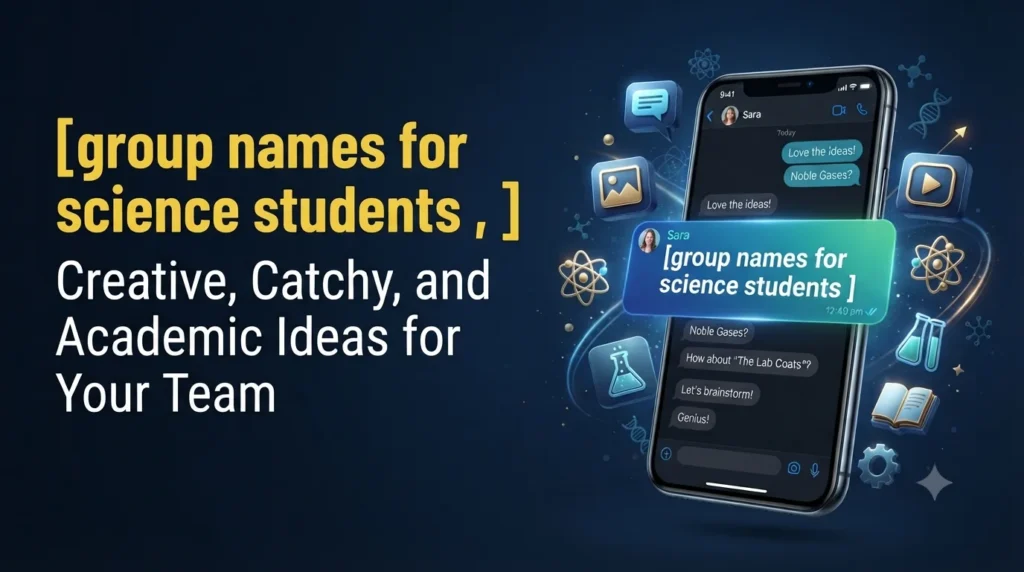
WhatsApp Study Group Chat
- Member 1: “Are we actually going with ‘Periodic Table Dancers’ for the project?”
- Member 2: “Too silly. Let’s go with ‘The Quantum Leapers.’ Sounds smarter for the presentation.”
- Member 1: “I love it. Done.”
Instagram DM between partners
- Person A: “We need a name for the Robotics submission. Something cool?”
- Person B: “How about ‘Bot Squad’? Or maybe ‘The Circuit Breakers’?”
- Person A: “‘Circuit Breakers’ is a winner. Let’s use that.”
TikTok comment section on a Science Fair video
- User 1: “Our group name is ‘The Noble Gases’ because we don’t react to stress.”
- User 2: “That is genius, literally stealing that for my group.”
Emotional & Psychological Meaning
Naming your group isn’t just about fun; it’s a psychological tool. When a group names itself, it undergoes a process called “identity formation.” By choosing a name, you are signaling to your peers that you are committed to this specific collective.
It creates a sense of belonging. In a high-pressure science program, feeling like you are part of a team—rather than just another student struggling through a syllabus—is crucial.
A Personal Perspective
I remember my own university days. We were stuck in a tedious microbiology rotation. Our group, “The Culture Club,” bonded over our name before we even bonded over the samples. That small layer of identity made the late nights in the lab feel like a shared mission rather than a chore.
Usage in Different Contexts
How you name your group depends entirely on who will be reading it. Context is everything.
- Social Media: You can be as punny, edgy, or niche as you want.
- Friends & Relationships: This is where you can use inside jokes that only your close circle understands.
- Work / Professional Settings: Keep it professional. Avoid “The Lab Rats” for a formal grant proposal. Opt for something like “Applied Research Initiative” instead.
- Casual vs. Serious: Use “The Physics Phantoms” for a casual club, but stick to “Research Group 4” for a formal thesis defense.
When NOT to Use It
While creativity is great, there are times when a quirky name can backfire.
Avoid overly complex or offensive puns. Science can be controversial, and you never want your group name to be interpreted as mocking a subject or a person. If you are presenting to a panel of professors, ensure the name doesn’t sound disrespectful to the gravity of your research. If in doubt, stay conservative.
Common Misunderstandings
People often think that a funny name implies a lack of seriousness. That is a myth. Many of the most brilliant research teams in history had humorous, informal names for their own internal collaboration.
Another mistake is choosing a name that is too long. If you can’t read it on a name tag, it’s too long. Keep it punchy, memorable, and easy to pronounce.
Comparison Table
| Name Style | Best For | Vibe |
| Punny | Casual study sessions | Lighthearted |
| Academic | Lab reports/Papers | Formal |
| Action-Oriented | Competitions/Robotics | Energetic |
| Mysterious | Theoretical research | Sophisticated |
Key Insight
The best names often bridge the gap between being technically accurate and socially relatable, providing a sense of unity that persists even after the project ends.
Variations / Types
- The Punny Scientists: “Periodic Table Dancers” (Plays on chemistry elements).
- The Intellectual Elite: “The Quantum Theorists” (Focuses on high-level concepts).
- The Problem Solvers: “The Solution Seekers” (Implies a results-driven mindset).
- The Lab Experts: “The Beaker Bunch” (Classic, playful imagery).
- The Future-Minded: “Innovate Labs” (Professional and forward-looking).
- The Biological Squad: “The Nucleus Crew” (For biology or pre-med groups).
- The Physics Fans: “Velocity Vectors” (Sounds fast and precise).
- The Nature Lovers: “Ecosystem Explorers” (Great for environmental science).
How to Respond When Someone Uses It
If a friend suggests a name that you love, acknowledge it immediately.
- Casual: “That’s perfect, count us in!”
- Funny: “If we don’t win, at least our name will be the best.”
- Mature: “That sounds very professional and fits our project goals well.”
- Respectful: “I think that’s a great way to represent our research.”
Regional & Cultural Usage
In Western cultures, science group names often lean toward humor and sarcasm. In contrast, academic environments in many Asian countries may favor more formal, achievement-oriented names.
Across the globe, the internet has homogenized these trends. Today, a group of students in Tokyo might use the same “meme-inspired” name as a group in London, proving that the language of science and humor is truly universal.
Is It Safe for Kids?
Absolutely. Encouraging kids to name their science groups is a wonderful way to foster engagement in STEM. It makes complex topics feel accessible and fun. Just ensure that the names they choose are school-appropriate and encouraging of positive team dynamics.
FAQs
How do I pick a name that everyone will like?
Start by having everyone suggest three names, then vote. This ensures everyone has a voice in the identity of the group.
Does a group name actually improve grades?
While it doesn’t change the data, it boosts group cohesion, which can lead to better collaboration and, ultimately, better work.
Can we change our name halfway through a semester?
You can, but it’s better to choose one and stick with it to build a consistent “brand” for your project.
What if my group is interdisciplinary?
Choose a name that focuses on the goal rather than the subject, like “The Innovation Collaborative.”
Is it okay to use a name from a movie or book?
Yes, pop culture references are a great way to bond, provided they aren’t protected by strict trademarks in a public-facing setting.
Conclusion
Your group name is the first chapter of your story as a team. Whether you choose something witty, professional, or purely experimental, make sure it reflects the energy you bring to your studies.
Don’t overthink it. Focus on what makes your group unique, grab a whiteboard, and let the brainstorming begin. You’ll be surprised at how much a simple name can transform a group of strangers into a powerhouse of scientific discovery. Embrace the process, have fun with your classmates, and let your team identity shine.