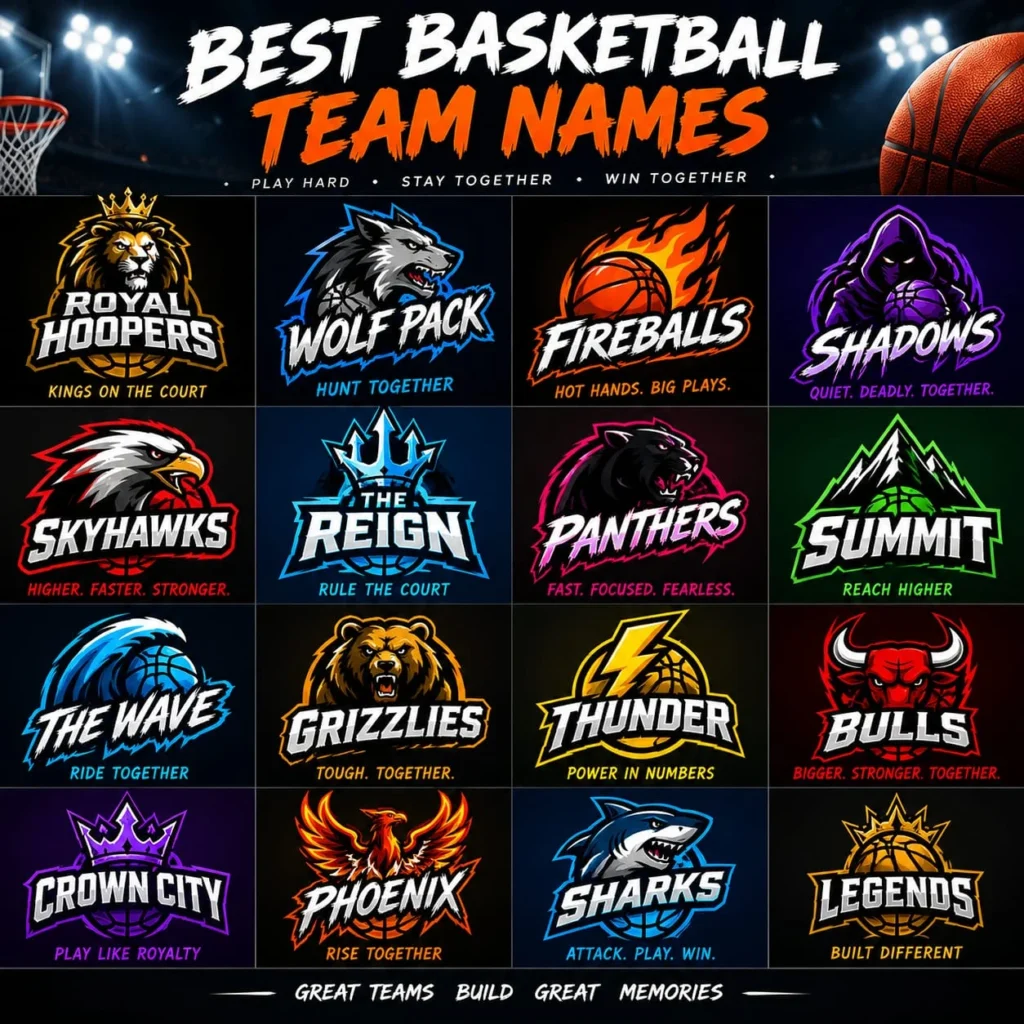
“Best basketball name” can mean a team name, a player nickname, or a username. This article covers the personal kind: nicknames, jersey names, and handles for individual players, built from how real NBA nicknames came about. For team names, see the earlier basketball articles on this site.
How real basketball nicknames start
A list of famous nicknames is less useful than knowing where they came from, because the origin tells you how to make your own. The real examples fall into a few groups:
- Self-chosen. Kobe Bryant created “Black Mamba” himself, inspired by Kill Bill and by the snake’s precision, according to Revolt. He told the LA Times, per Bleacher Report, that a mamba strikes with near-perfect accuracy at high speed, the kind of precision he wanted in his game.
- Given by a teammate. Revolt says Shaquille O’Neal coined “Flash” for a young Dwyane Wade when they were Miami teammates.
- Born from the crowd. Kevin Garnett became “The Big Ticket,” Bleacher Report says, because the arena filled for him every night.
- Evolved from something simple. Ben Wallace was first just “Big Ben” for his size. It then took on the London clock tower, so a bell tolled when he entered the game.
- From a tagline. Karl Malone’s “The Mailman” took off with the line “the Mailman always delivers,” per Revolt.
- From a jersey number. Gilbert Arenas wore zero in Washington, which fed “Agent Zero,” per Bleacher Report.
- From a commercial. A listing says Larry Johnson’s “Grandmama” came from Converse commercials in which he played his own grandmother.
- One that overtook the real name. Bleacher Report says “Magic” was so good it basically became Earvin Johnson’s first name.
Revolt also makes the point that nicknames function as brands, living on jerseys, in commercials, and in group chats long after a career ends.
Notice the pattern in what Bleacher Report calls the lazy ones: initials-plus-number nicknames like CP3 or CB4. They’re easy, but they tell you nothing about the player. A name that connects to something real about how you play lasts longer.
A formula that works
Most good basketball names combine three things:
- A trait: what you do better than anyone on the court (shoot, pass, protect the rim, finish late).
- An image: a concrete object or character that carries the trait.
- A sound: something short enough to shout and with a good rhythm.
Names by playing style
These are original, so they don’t copy real NBA nicknames.
Shooters
- The Metronome (steady and rhythmic)
- Late Fee (scores late in games)
- Last Call (the closer)
- Nylon (the swish)
Passers
- The Librarian (quiet, precise)
- Dime Dispatcher
- Switchboard
- Air Traffic
Rebounders and bigs
- The Vacuum
- Glue
- Drawbridge
- Skyscraper
Shot blockers
- Rejection Letter
- Return to Sender
Defenders
- Seatbelt
- Velcro
- Shadow
- Handcuffs
Ball handlers
- Houdini
- Slinky
- Yo-Yo
- Ankle Insurance (for the player who ties up defenders)
Smaller players
- Pocket Rocket
- Mighty Mite
Usernames and handles
For a gamertag or social handle, combine a trait with a concrete job or object:
- SwishSurgeon
- PaintPlumber
- BaselineBaker
- LayupLawyer
- DimeDoctor
I can’t confirm whether any specific handle is free on a platform, so search for it first. A handle that works as both a nickname and a username is especially useful, since you can use the same name on a jersey, a gamertag, and a profile.
Tests for any basketball name
- The announcer test. Can an announcer say it clearly?
- The jersey test. Does it fit on the back of a shirt?
- The pairing test. Does it work with your real name, like “Maya ‘Late Fee’ Torres”?
- The growth test. Will it still fit in two years? Names tied to age or height can age out.
- The originality test. Check that it isn’t already a famous nickname or another player’s, since a copy of an established name usually reads as a joke.
Name sources compared
| Source | Real example | Strength | Risk |
|---|---|---|---|
| Self-chosen | Black Mamba | Total control of the image | Needs backing it up |
| Teammate-given | Flash | Feels earned | You can’t force it |
| Crowd-born | The Big Ticket | Tied to real impact | Takes time |
| Tagline | The Mailman | Easy to remember | Needs a good line |
| Jersey number | Agent Zero | Built-in identity | Only works with a distinctive number |
| Initials plus number | CP3 | Fast | Generic |
FAQ
What’s the difference between a nickname and a username?
A nickname is what teammates and fans call you, and a username is what you type into an app. Using the same name for both makes you easier to recognize.
Should I pick my own nickname or wait for one?
Both happen. Kobe chose his, while Wade’s came from Shaq, so a self-chosen name can work if you earn it. If you give yourself one, use it consistently so it sticks.
Do initials and numbers work?
They can for a handle, but the nicknames described as lazy are the ones that tell you nothing about the player. A trait-based name does more.
How long should the name be?
One to three words is plenty. Shorter names fit on a jersey and are easier for an announcer to say.
What if the nickname doesn’t catch on?
Some take years to develop, as Big Ben’s did. Keep using it, and if teammates keep riffing on it, that’s a good sign.
Can I use a famous nickname?
It’s better not to. A copy of a famous name tends to look like a joke, and it’s harder to be searched for or remembered.
Conclusion
The best basketball names come from something real about how you play, such as a trait, an image, and a sound that’s easy to shout. Real nicknames came from the player, a teammate, the crowd, a tagline, or a jersey number, so use whichever route fits your situation. Check the announcer, jersey, and growth tests, avoid initials-only handles unless you need them, and don’t copy famous names.