Team Name Meaning: A Clear Guide to the Phrase
A team name is the name a group chooses or receives to identify itself. It might belong to a cricket squad, a school project group, a workplace department, an esports team, or a group of friends competing together. The phrase is ordinary English, not slang or an acronym.
The meaning can be straightforward, but the reason behind a particular team name often says more about the group: its identity, shared humor, purpose, or competitive spirit.
What Does “Team Name” Mean?
The phrase has two parts:
- Team: A group of people working together, playing together, or sharing a common goal.
- Name: A word or phrase used to identify a person, place, organization, or group.
Together, team name means the identifying label for a team.
For example:
- The Thunderbolts might be the name of a cricket team.
- Code Crafters might identify a software development team.
- Quiz Wizards could be the name of a trivia group.
- The Night Owls might be the name of a recreational sports team.
These are illustrative examples, not claims about particular registered teams. Each name gives the group a recognizable identity.
Does “Team Name” Have More Than One Meaning?
The basic definition stays the same, but the phrase can refer to different things depending on context.
1. A sports team’s name
In sports, a team name identifies a club, squad, or group of players. It may refer to an animal, a place, a color, a historical figure, or an idea associated with strength and competition.
For example, if someone asks, “What is your team name?” before a cricket tournament, they want to know what the team is called.
2. A workplace or project group’s name
At work, a team name can identify a department, project group, or temporary team formed to solve a problem. A company might use a descriptive name such as “Customer Success Team” or a more creative one such as “Launch Crew.”
Here, the purpose is often identification and coordination rather than competition.
3. A gaming or online group’s name
In multiplayer games and online communities, a team name can distinguish a squad from other groups. It may be serious, humorous, intimidating, or deliberately unusual.
A team name is not automatically the same as a player’s username or gamer tag. The team name identifies the group, while a username generally identifies an individual account.
4. A group’s shared identity
Sometimes, the phrase means more than the label printed on a jersey or shown on a screen. A team name can become a symbol that members use to express belonging, shared memories, or a common goal.
That meaning comes from the group’s experiences with the name; it is not a separate dictionary definition.
Is “Team Name” Slang, an Acronym, or an Abbreviation?
“Team name” is a standard English noun phrase. It is not an acronym, abbreviation, or secret texting expression. If someone types “team name?” in a group chat, they are usually shortening the question “What should we call our team?” or “What is the name of our team?”
The phrase should also be distinguished from “Team [Person’s Name]”. Expressions such as “Team Alex” can mean a group organized around Alex, or people who support Alex in a disagreement or choice. Linguistic commentary traces the broader “Team X” construction through sports and business uses, then through entertainment fandom and political discussion, while noting that its exact early history is not entirely settled.
languagelog.ldc.upenn.edu
Why Do Teams Choose Particular Names?
A name can do several jobs at once. It identifies the group, helps people remember it, and sets expectations about its personality.
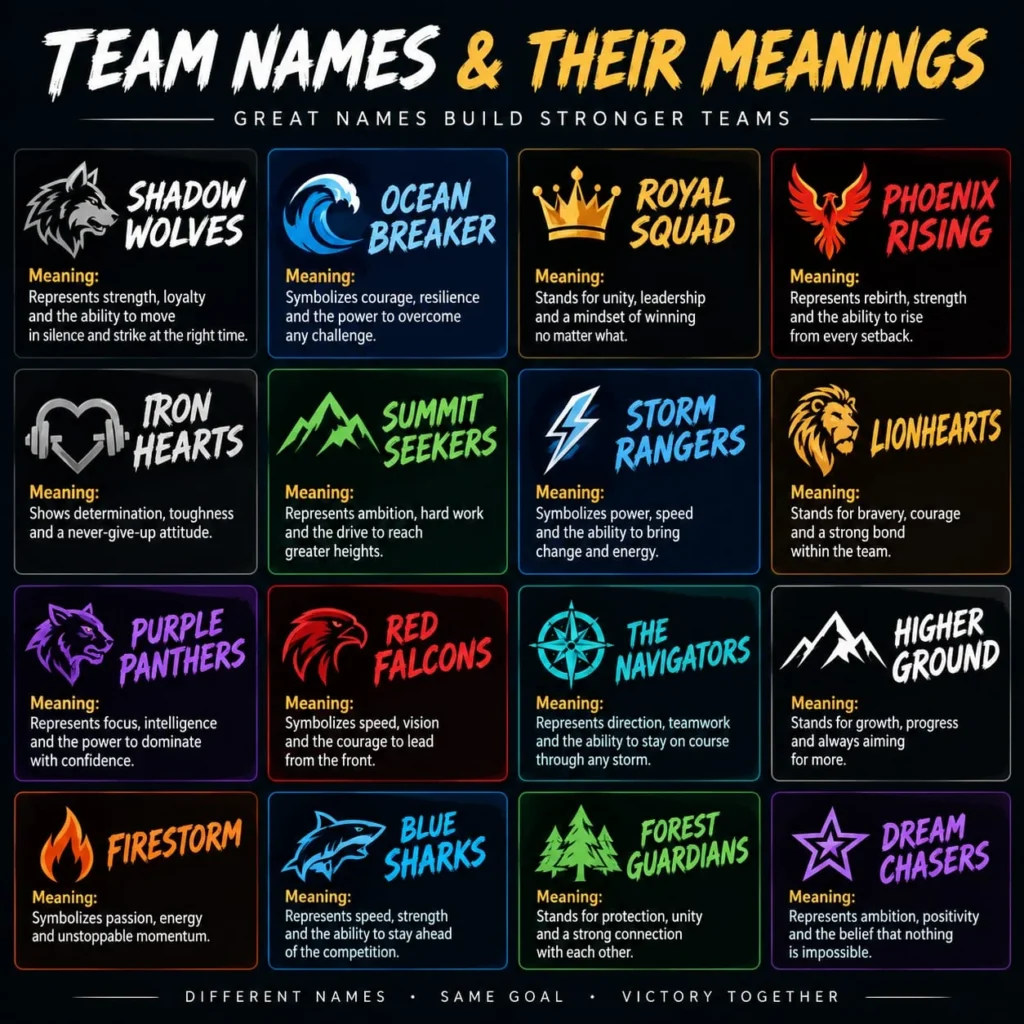
| Naming approach | Example | What it communicates |
|---|---|---|
| Strength-based | Iron Falcons | Toughness and determination |
| Teamwork-focused | United Crew | Cooperation and shared effort |
| Funny | The Last-Minute Legends | Humor and self-awareness |
| Purpose-based | Code Crafters | The group’s work or skill |
| Place-based | Multan Strikers | A connection to a location |
| Inside joke | The Missing Lunch | A shared memory among members |
These meanings are interpretations of the examples, not fixed definitions. “Iron Falcons” does not have a universal meaning beyond its words and the symbolism its members attach to it.
That distinction matters when choosing a name: the meaning people intend is not always the meaning other people hear. A joke that works within a close group may be confusing to strangers, while a descriptive name can make a team’s role immediately clear.
What Do Search Results Commonly Explain—and What Do They Miss?
Many pages ranking for team-name-related searches focus on large lists of suggested names, often grouped by themes such as sports, humor, work, or strength. Some explain the intended meaning of individual suggestions, which is useful when someone is choosing a name.
TeamNameNest
+2
However, those lists don’t always make three important distinctions clear:
- The phrase versus the name itself: “Team name” means the label for a group; a particular name such as “Thunderbolts” has its own intended associations.
- Literal meaning versus symbolism: A name may literally refer to an animal or object but symbolically suggest speed, loyalty, or strength.
- Official name versus casual label: A group might have a registered club name, an informal nickname, and a temporary name for one competition. Those are not necessarily interchangeable.
These distinctions help readers understand the phrase instead of simply collecting name ideas.
Example Conversations: How “Team Name” Is Used
The examples below are illustrative conversations showing different ways the phrase might appear. They are not quotations from real people or evidence of use on a specific platform.
1. Funny: Friends choosing a quiz name
Maya: We need a team name before the quiz starts.
Leo: How about “Professionally Confused”?
Maya: That’s not a name. That’s our official condition.
Leo: Great. Then it’s accurate.
2. Sarcastic: A group chat going nowhere
Sam: Has anyone suggested a team name yet?
Nina: Yes, about seventeen people have suggested that someone else should choose one.
Sam: Brilliant. Let’s call ourselves “The Decision Makers.”
Nina: Perfectly ironic.
3. Playful: A school sports event
Ayaan: Coach says we need a team name for Friday.
Hamza: “The Speedy Samosas”?
Ayaan: Are we playing football or opening a food stall?
Hamza: Why not dominate both fields?
4. Serious: A workplace project
Priya: The project form asks for a team name. Should we use our department name?
Daniel: That would be clear, but the project is temporary.
Priya: Then let’s use “Customer Journey Group.”
Daniel: Good. It tells everyone what we’re working on.
5. Family: A reunion game
Aunt Sara: What team name are we using for the family competition?
Bilal: “The Winning Branch.”
Cousin Hina: You said that last year and came last.
Bilal: The name represents our ambition, not our history.
6. Gaming: An online squad
Rex: We need a team name for the tournament registration.
Nova: “Night Circuit” sounds good.
Rex: It sounds mysterious. Does it mean anything?
Nova: Not officially. We just like how it sounds.
7. Dating: A couple entering a trivia night
Ella: We signed up for trivia. What should our team name be?
Noah: “Two Brains, One Answer”?
Ella: Confident, considering you forgot the restaurant reservation.
Noah: Then perhaps “One Brain, Shared Custody.”
8. Coworkers: A company challenge
Omar: HR wants our team name for the step-count challenge.
Mei: “The Walking Meetings”?
Omar: That sounds like our normal workday.
Mei: Exactly. We should choose a name based on our strongest skill.
9. Competitive: A cricket tournament
Usman: What name are we putting on the team sheet?
Faraz: “Boundary Hunters.”
Usman: Does everyone agree?
Faraz: We do now. You asked us after the deadline.
10. Neutral: Someone asking what a phrase means
Lily: The registration page says “team name.” What should I enter?
Chris: Enter the name your group will compete under.
Lily: So it doesn’t mean my personal username?
Chris: Correct. It’s the name of the whole group.
How Should You Reply When Someone Asks for a Team Name?
The best response depends on whether the person wants an idea, needs an official label, or is simply asking what your existing team is called.
Funny reply
“Let’s call ourselves ‘The Almost Champions.’ It gives us room to improve.”
Serious reply
“Let’s use a name that reflects our purpose and is easy to recognize on the registration form.”
Neutral reply
“Do you mean the name of our existing team, or are we choosing a new one?”
Flirty or playful reply
“Let’s pick a name together. If we’re a team, we should both get a vote.”
A flirty answer only makes sense when the conversation already has a romantic or teasing tone. In a workplace, school registration, or formal competition, a clear and direct answer is usually better.
Team Name vs. Similar Terms
“Team name” is easy to understand, but it is not interchangeable with every label used for a group. The distinctions below reflect ordinary English usage; popularity is qualitative rather than a measured search ranking.
| Term | Meaning | Tone | Popularity | Confusion risk |
|---|---|---|---|---|
| Team name | The name identifying a group | Neutral | Very common | Low |
| Squad name | A name for a smaller or close-knit group | Casual | Common in informal contexts | Low |
| Group name | A broad label for any group | Neutral | Very common | Low |
| Team nickname | An informal or alternate name for a team | Friendly or playful | Common | Medium |
| Team identity | The wider image, values, or personality associated with a team | Descriptive | Common in organizational contexts | Medium |
| Username | A name identifying an individual account | Digital or personal | Very common online | Medium |
The Cambridge Dictionary defines a team as people or animals acting together as a group, including sports teams and workplace groups. Merriam-Webster lists terms such as “crew” and “squad” among related words, although their exact meanings depend on context.
definition in the Cambridge English Dictionary
+1
There is no universal opposite of “team name.” If you need a contrast, “individual username” works when explaining the difference between a group label and a name for one person’s online account. It is a contrast in function, not a strict antonym.
Who Uses the Phrase “Team Name”?
People use the phrase wherever groups need to be identified. It is common in sports registrations, school activities, workplace projects, competitions, gaming, and informal group planning.
- Children and teenagers may encounter it in school sports, class projects, quizzes, and games.
- College students and young adults may use it for societies, competitions, gaming squads, or social events.
- Adults and workplace teams may use it for departments, project groups, training activities, and company challenges.
- Sports organizers and club members may need an official name for schedules, results, jerseys, or registration forms.
The setting and the specific name are more informative than the age or gender of the person using it.
Regional language can affect which name sounds natural or funny, but there is no single regional meaning of the phrase itself established by the sources reviewed here.
Is “Team Name” Rude or Safe to Use?
Yes, the phrase itself is neutral and generally appropriate for school, work, family conversations, and public competitions. It contains no profanity or inherently offensive meaning.
The chosen team name, however, can create problems. A name that insults a group of people, includes discriminatory language, uses someone else’s private information, or makes a coworker the target of a humiliating joke may be inappropriate even though the phrase “team name” is harmless.
For a workplace or school, choose something easy to understand and respectful. For a private gaming or friends’ group, the name can be more playful, provided it does not violate the group’s rules or target someone unfairly.
If a team competes publicly, check whether its organizer has naming rules. A name accepted in a private group chat might not be suitable for a printed tournament schedule or a company event.
Why a Team Name Can Matter More Than It Seems
A team name gives a group a short label that people can remember and repeat. That is useful when members need to coordinate, recognize one another, or feel that they belong to the same group. A name can also communicate a first impression before anyone has seen the team play or worked with its members. The effect depends on context: “The Data Detectives” tells colleagues something about a project’s focus, while “The Last-Minute Legends” makes a joke about the group’s habits. The words create an initial impression, but the group’s actual behavior eventually gives that name its lasting meaning.
Frequently Asked Questions
1. What does “team name” mean in simple English?
It means the name used to identify a team or group of people. For example, if your cricket team is called “Boundary Hunters,” that is your team name. It can be serious, funny, descriptive, or creative.
2. What does “team name” mean in a text message?
In a text message, it usually means someone is asking what a group is called or suggesting that the group choose a name. If a friend writes “Need a team name,” they probably want suggestions. The phrase does not have a separate hidden texting meaning.
3. Is “team name” an acronym?
No. It is an ordinary two-word English phrase made from “team” and “name.” It is not a shortened form of a longer expression.
4. What is the difference between a team name and a username?
A team name identifies the whole group, while a username identifies an individual account on a service or platform. One person may use the username “AliPlays” while belonging to a team called “Thunder Strikers.” The two names can be related, but they serve different purposes.
5. Can a team name have a hidden meaning?
Yes, a particular name can refer to an inside joke, a shared experience, a cultural reference, or a personal story. However, the meaning is not automatically obvious to outsiders. If the group has not explained the reference, it is better to ask than to assume.
6. Does every team need an official name?
No. Informal groups can work together without choosing a special name. An official name becomes useful when the group needs to register for a tournament, appear on a schedule, represent an organization, or distinguish itself from other teams.
7. What makes a good team name?
A good name is easy to say, easy to remember, suitable for the group’s purpose, and acceptable to its members. It can reflect a shared interest, location, skill, or sense of humor. For public or professional use, it should also be respectful and distinct enough not to be confused with another group.
8. Is “Team Alex” the same as a team name?
It can be, but the context matters. “Team Alex” might identify a group led by someone named Alex, or it might mean people who support Alex in a disagreement or fictional storyline. This “Team + name” construction can express affiliation or preference rather than identify a formal sports or work team.
languagelog.ldc.upenn.edu
+1
Conclusion
The meaning of “team name” is simple: it is the label used to identify a group. The phrase is standard English, not slang, an acronym, or an abbreviation. What makes an individual team name interesting is the idea or story behind it, whether that is a sport, a shared goal, a joke, or a group identity.
When you see the phrase on a form, in a message, or during a competition, look at the context to determine whether someone wants the name of an existing group or is asking you to create one. And when choosing a name, make sure it fits the team, communicates the intended impression, and works for the setting in which it will be used.