The Secret Social Code of Choosing Your Crew’s Identity
We have all been there, standing in a circle of semi-strangers or close colleagues, minutes before a charity golf tournament, a corporate trivia night, or a weekend gaming marathon.
The clipboard is passed around, and the organizer looks at you with an expectant smile, asking for your official designation.
Suddenly, the pressure shifts from the actual competition to a test of pure wit and collective personality.
People search for the perfect combination of words because a group identity acts as an instant psychological icebreaker.
It bridges the gap between anxiety and camaraderie, transforming an awkward gathering into a unified front.
The ultimate goal is to find a phrase that strikes the perfect balance between self-deprecating humor and competitive spirit.
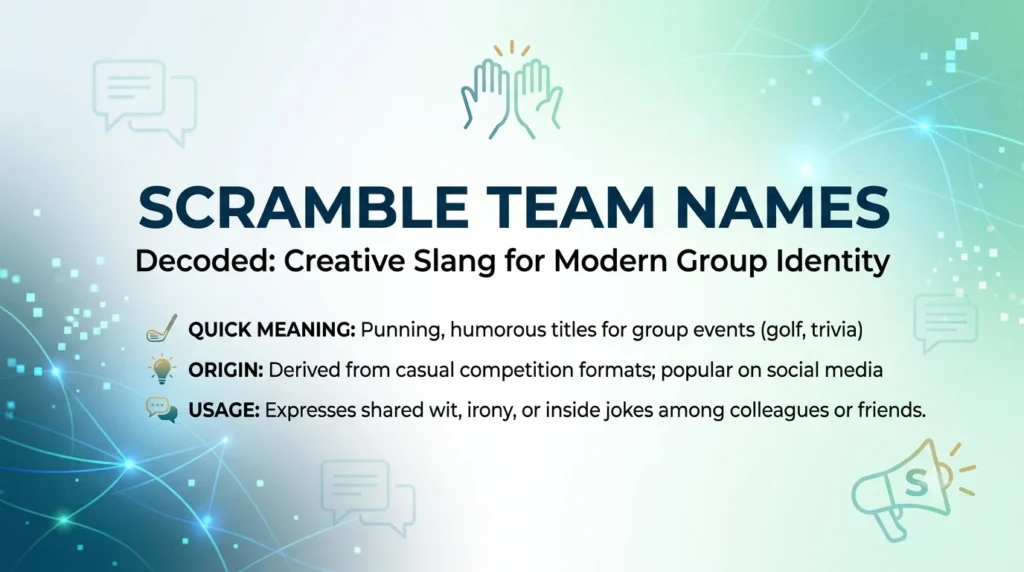
Scramble Team Names – Quick Meaning
Decoding the Team Identity Phenomenon
At its core, the concept refers to the unique, often humorous titles chosen by groups participating in a “scramble” format event.
In sports like golf, a scramble means everyone works together, choosing the best shot from the group to move forward.
In corporate or social settings, it represents a chaotic, fast-paced collaboration where diverse minds blend into one. Therefore, the name must reflect this collective energy.
- The Unifying Element: It instantly creates a shared sense of ownership over wins and losses.
- The Humor Shield: It uses wit to lower expectations and reduce the stress of performance.
- The Cultural Bridge: It leverages shared inside jokes, pop culture, or industry jargon to build trust.
“We aren’t just playing a game; we are building a temporary micro-culture, and our name is our flag.”
“A great title makes you memorable long after the final scoreboard is wiped clean.”
Origin & Background
From the Fairways to the Office Cubicle
The tradition deeply traces its roots back to traditional Scottish golf formats, where the “scramble” allowed players of all skill levels to enjoy the game without individual embarrassment.
As the format moved across the Atlantic, it quickly became a staple of charity fund-raisers and corporate networking events in the mid-20th century.
With the rise of corporate team-building culture in the 1990s, the practice escaped the golf course entirely and entered conference rooms.
The Digital Shift and Viral Impact
In the era of modern internet culture, the process of naming your squad has turned into a viral social media art form.
Platforms like TikTok and Instagram regularly feature videos of coworkers or friends revealing their hilarious group titles, turning a simple organizational step into high-entertainment content.
Today, it has evolved from a simple label on a scorecard into a reflection of a group’s collective quick wit and online sensibilities.
Real-Life Conversations
The Late-Night WhatsApp Panic
Person A: Guys, the charity tournament registration closes in exactly ten minutes. What are we putting down for our slot?
Person B: Oh no, I forgot! Can we just use our last names?
Person A: Absolutely not, that sounds like a boring law firm. We need something funny.
Person B: How about “Subpar Heroes”? Because our golf skills are genuinely terrible, but we try hard.
The Instagram DM Coordination
Person A: Hey! For the weekend trivia scramble, did we ever settle on a brand for the group?
Person B: Not yet, everyone is arguing in the main group thread.
Person A: Let’s just surprise them with “The Google Docs Enthusiasts.” It fits our work vibe perfectly.
Person B: Love it. Sending that to the coordinator right now before anyone can veto it!
The TikTok Comment Section Debate
User 1: Our corporate retreat forced us into groups and we named ourselves “The Vibe Checkers.” The CEO looked so confused. 😂
User 2: Omfg that is amazing, we went with “Circle Back Later” and got a standing ovation from management!
User 1: Honestly, making the executives laugh is the easiest way to win the whole day.
Emotional & Psychological Meaning
The Need for Instant Belonging
Choosing a collaborative identity satisfies a deep-seated human desire for psychological safety within a group.
When we step into a competitive or unfamiliar environment, our brains naturally signal a status of social vulnerability.
By aligning under a clever, self-selected title, the group establishes an internal culture that buffers against the fear of failure.
What it Reveals About Modern Connection
In our fast-paced digital world, communication is often brief, transactional, and isolated.
Participating in a collective naming ritual forces us to slow down, share a laugh, and find common ground.
It reveals that despite our increasing reliance on independent screens, we still crave the joy of collective achievement and shared humor.
A Firsthand View of the Dynamics
During a regional corporate summit I facilitated last year, I watched a team of incredibly quiet, introverted analysts transform completely.
They were struggling to connect until they jokingly named their trivia group “The Error Code 404s.”
That single moment of shared, self-deprecating humor dissolved all structural hierarchy and allowed them to communicate seamlessly for the rest of the weekend.
Usage in Different Contexts
Navigating the Social Media Feed
On social platforms, these group names serve as excellent hooks for video captions, photo dumps, and event hashtags.
They allow groups to share their real-world memories with their online communities in a way that feels instantly witty and visually engaging.
A clever title turns a standard group photo into a highly shareable piece of personal storytelling.
Friends and Intimate Relationships
Among close friends, the naming process is heavily driven by deep inside jokes, shared historical memories, and mutual experiences.
It functions as an emotional anchor that reinforces the unique bond of that specific inner circle.
In these casual settings, the phrases can be highly specific, obscure, and unapologetically silly.
The Professional and Corporate Landscape
In a workplace setting, navigating the naming process requires a delicate balance of humor and professional boundaries.
The ideal corporate team title gently pokes fun at office tropes—like endless meetings or email sign-offs—without crossing into genuine cynicism.
It allows employees to blow off steam and express personality while remaining completely respectful to the brand.
When NOT to Use It
High-Stakes and Formal Environments
While a witty name is fantastic for casual and charity events, it is entirely inappropriate for formal, high-stakes professional presentations or client-facing pitches.
Using overly casual or humorous titles in front of potential investors can severely undermine your perceived authority and expertise.
When millions of dollars or serious organizational decisions are on the line, stick to clean, direct terminology.
Navigating Cultural Sensitivity
It is vital to avoid any puns or phrases that mock cultural backgrounds, regional accents, or sensitive historical events.
What might feel like a harmless play on words to your immediate friend group can easily alienate or offend others in a larger public setting.
Always review your choice through a lens of inclusivity to ensure your fun doesn’t come at someone else’s expense.
Common Misunderstandings
The Trap of Literal Interpretations
A frequent mistake people make is assuming that the title must literally describe the exact activity they are performing.
For instance, a golf scramble group doesn’t need to have the words “golf,” “club,” or “ball” anywhere in their title to be effective.
The best choices focus on the mood, the personality, and the shared spirit of the participants rather than the mechanical rules of the event.
Misreading the Underlying Tone
Sometimes, outside observers can misinterpret self-deprecating titles as a genuine lack of effort or competitive drive.
In reality, teams that use humorous, relaxed names are often highly focused and strategically collaborative.
The lighthearted title is simply a psychological tool used to relieve performance anxiety, not an indication that they don’t care about winning.
Comprehensive Expression Comparison
| Expression Style | Primary Social Vibe | Best Suited Environment | Potential Social Risk |
| Puns & Wordplay | Witty, clever, lighthearted | Office trivia, local charity events | Can feel cheesy if overdone |
| Self-Deprecating | Relatable, humble, funny | Casual golf, beginner sports | Might look like low confidence |
| Hyper-Competitive | Bold, aggressive, intense | Semi-pro leagues, high-stakes gaming | Can alienate casual players |
| Pop Culture References | Trendy, modern, youthful | College events, social media streams | Fades quickly as trends change |
Key Insight
Finding Your Group’s Perfect Balance
The absolute best identities always live at the intersection of situational awareness and authentic group energy, ensuring everyone feels included without alienating the audience.
Variations and Types of Team Themes
The Office Satirists
- The Reply Alls: A nod to the ultimate workplace email faux pas.
- Per My Last Email: Perfect for a group that loves corporate sass.
- The Circle Backs: For teams that excel at delaying decisions beautifully.
The Casual Competitors
- The Subpar Crew: A clever double meaning perfect for a golf green.
- The Participation Trophies: Embracing the joy of just showing up.
- The Underdogs In Training: For groups that love a good comeback story.
The Clever Wordsmiths
- The Agatha Quizties: An excellent choice for a sharp trivia night squad.
- The Syntax Errors: Perfect for tech teams with a sense of humor.
- The Brain Cells Shared: For close friends who think completely in sync.
How to Respond When Someone Uses It
The Casual and Friendly Approach
When a teammate suggests a funny title, a warm, validating response helps build instant momentum for the day.
You can say something like, “That is absolute gold, let’s definitely write that down before someone else steals it!”
This keeps the energy high and ensures everyone feels heard and appreciated.
The Humorous and Witty Reply
If you want to match their comedic energy, you can playfully build upon their suggestion to see how far the joke can go.
Try responding with, “Perfect, but only if we all agree to wear matching hats to fully commit to the joke.”
This shows you are fully invested in the shared experience and ready to have fun.
The Mature and Supportive Response
In situations where the group is mixed-age or professional, keeping your validation grounded and encouraging works beautifully.
A response like, “That strikes the perfect balance of being lighthearted while still keeping us focused,” works wonders.
It acknowledges the humor while subtly steering the group back toward preparing for the actual event.
Regional & Cultural Usage
Western Perspectives on Group Humour
In North American and UK cultures, there is a massive emphasis placed on irony, pop culture references, and self-deprecation.
Teams actively compete to have the funniest or most sarcastic title on the master registration sheet.
It is seen as a direct reflection of a group’s confidence, social intelligence, and approachability.
Eastern and Middle Eastern Frameworks
In many Asian and Middle Eastern cultures, group identities traditionally lean toward themes of unity, honor, and collective progress.
While humor is absolutely appreciated, public-facing titles often focus more heavily on strength, harmony, and mutual respect.
The focus is on uplifting the organization or community as a whole rather than prioritizing individual wit.
The Digital Generational Divide
There is also a fascinating shift happening between generations on global internet platforms.
Millennials often prefer highly structured puns, nostalgia, and clever workplace irony that reflects their professional journeys.
Meanwhile, Gen Z favors surrealism, hyper-specific internet memes, and deeply self-aware, lower-case energy that challenges traditional competitive structures.
Is It Safe for Kids?
Keeping the Fun Family-Friendly
When organizing events that involve children, youth sports, or school functions, the naming process requires a bit of adult guidance.
Kids love wordplay, but they can occasionally wander into edgy territory without understanding the double meanings behind certain adult jokes.
Encourage them to focus on their favorite animals, video games, cartoon characters, or food combinations.
This keeps the environment completely safe, highly encouraging, and wonderfully age-appropriate for everyone involved.
Frequently Asked Questions
Why do people use humorous names for serious scramble events?
Humor acts as an intentional psychological tool to lower performance pressure, allowing participants to bond easily and perform better without anxiety.
Can a team name impact our performance during a competition?
Yes, psychologically, a title that makes the team laugh boosts positive morale, builds instant trust, and fosters open, stress-free communication.
What should we do if our group cannot agree on a single name?
The simplest solution is to have everyone write down one option on a slip of paper and draw blindly from a hat to keep things fair.
Is it acceptable to change our group identity mid-season?
Absolutely, updating your title to reflect a new inside joke or a turning point in your journey keeps the experience fresh and engaging.
How long should an ideal team title be for a scorecard?
Keep it between two to four words so it remains easy to read, fits nicely on registration forms, and stays memorable for the hosts.
Embodying the Spirit of Collaboration
At the end of the day, the words you write down on that initial registration sheet are far more than just a tracking label.
They represent a shared moment of human connection, a creative compromise, and a conscious decision to face a challenge together with a smile.
Whether you win the grand trophy or finish dead last, the shared laughter behind your identity is what truly endures.
So, the next time you are handed the clipboard, don’t overthink the pressure or settle for something completely uninspired.
Lean into your group’s unique, authentic energy, embrace the fun of the moment, and proudly claim your space on the board.