The Cultural Phenomenon of Soccer Branding
When you hear someone shout “Hala Madrid” across a crowded room or see a crimson jersey with a golden liverbird stamped on the chest, you are witnessing more than just sports fandom. Consequently, you are looking at a deeply ingrained language of global identity. People search for popular soccer team names not just to look up stats, but rather to find a community, understand a subculture, or even name their own local club.
In contrast to casual sports, the confusion usually starts when observers try to parse the differences between official corporate club names, historical community titles, and the passionate nicknames used by fans. Therefore, a team is rarely just a city followed by “FC.” Instead, it carries centuries of political, social, and emotional weight wrapped into a few syllables.
Ultimately, understanding these names solves the disconnect between the official scoreboard and the living, breathing language used in stadium terraces and social media feeds. Whether you are building a fantasy league, writing a sports column, or alternatively trying to understand what your friends are shouting about in the group chat, breaking down these names unlocks a rich cultural code.
Popular Soccer Team Names – Quick Meaning
Decoding the Global Football Lexicon
At its core, a soccer team’s identity is divided into its official registered name and its globally recognized moniker. Furthermore, official names usually feature foundational acronyms that point directly to the club’s roots or structure.
- FC / SC / AC: Football Club, Soccer Club, or Associazione Calcio (Association Football).
- United: Traditionally signified the merging of multiple local clubs into one cohesive unit.
- Real: Meaning “Royal” in Spanish, a title historically bestowed by Spanish monarchs upon specific clubs.
Iconic Examples in Action
“We are heading down to Old Trafford this weekend to see the Red Devils play.”
“If you want to see pure tactical art, you have to watch the Blaugrana orchestrate their midfield.”
Origin & Background
Where the Magic Begins
The oldest popular soccer team names grew organically from the working-class neighborhoods of nineteenth-century Europe and South America. Specifically, they were not focus-grouped by branding agencies; rather, they were born in coal mines, shipyards, and railway stations.
Cultural and Historical Influences
In England, for instance, teams like West Ham United grew from the Thames Ironworks, earning them the timeless name “The Hammers.” Meanwhile, across the English Channel, real-world political movements shaped titles; Spanish clubs added “Real” to showcase their allegiance to King Alfonso XIII in the early twentieth century.
The Modern Social Media Metamorphosis
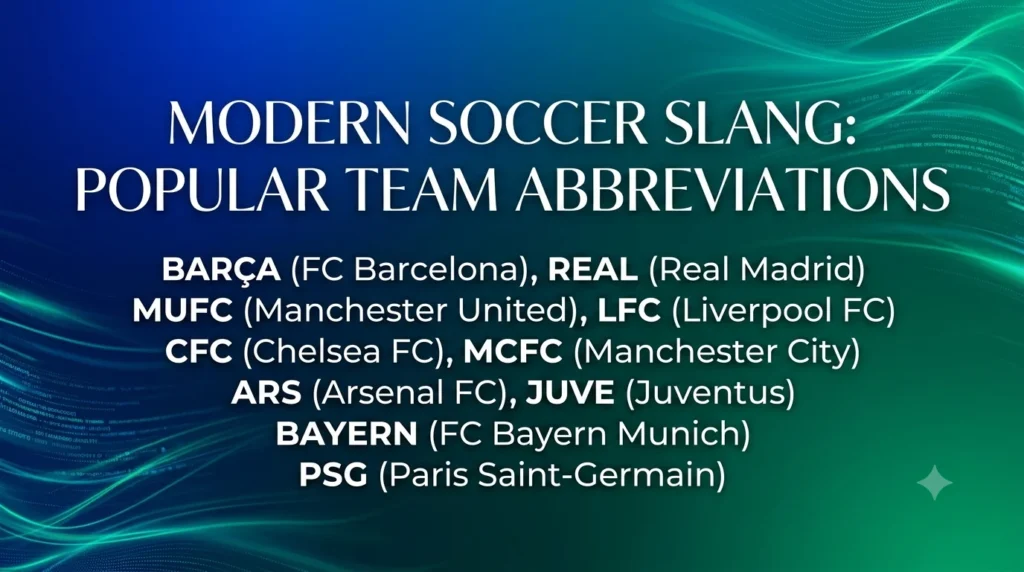
In our hyper-connected digital landscape, these names have subsequently transformed into global hashtags. Tik Tok edits and Instagram captions have shortened legendary titles into snappy acronyms like “PSG” or “Juve,” turning local athletic clubs into massive lifestyle brands.
Real-Life Conversations
The Matchday WhatsApp Group Chat
Person A: Are we watching the match at your place tonight?
Jiya: Only if you promise not to cry when the Sky Blues completely dominate the midfield.
Person A: Please, your defense has been shaky all month, so we are taking the three points back home!
Instagram DM Debate
Person A: Did you see that incredible overhead kick from the wild match last night?
Person B: Absolute class! That is exactly why they call them the Galácticos.
Person A: Honestly, they look unstoppable this season, plus the chemistry is unreal.
TikTok Comment Section
Person A: Everyone in the comments acting like the Red Devils didn’t completely build modern counter-attacking football. 😂
mohtashm: That was twenty years ago bro, welcome to the modern era.
Person A: History doesn’t just vanish because of a few bad transfer windows!
Casual Weekend Text Message
Person A: Hey, picking up snacks for the game, do you want anything specific?
Waqar: Just get some chips, I am already too nervous to eat while watching the Bianconeri today.
Person A: Relax, it is a home game, so they always lock down the stadium.
Emotional & Psychological Meaning
The Psychology of the Collective Moniker
Adopting a soccer team’s name as part of your personal vocabulary is an act of psychological mirroring. Indeed, it fulfills a deep human need for tribal belonging and shared narrative. When a fan says “we won,” they are expressing a profound emotional investment that transcends standard consumer behavior.
What Modern Team Names Reveal About Us
In a fragmented world, these historic titles offer stability. Accordingly, they allow individuals from completely different socio-economic backgrounds to stand shoulder to shoulder, speaking the exact same linguistic shorthand.
A Personal Snapshot from the Terraces
I remember standing in a packed train heading toward Anfield on a freezing cold November afternoon. An older gentleman next to me, noticing my scarf, nodded and simply said, “Big day for the Reds.” In that single phrase, all generational divides vanished; consequently, we were instantly bound by a century of shared heritage.
Usage in Different Contexts
Navigating the Digital Turf
On social media platforms, popular soccer team names serve as global search indexes and community beacons. Dropping a team’s nickname into a tweet instantly broadcasts your allegiance to millions of fans around the planet within milliseconds.
Friends and Intimate Relationships
Within friend groups, using these names is the ultimate catalyst for playful banter. It creates a space for controlled rivalry where friends can mock each other’s chosen allegiances without causing genuine offense.
Workplace Boundaries
Professional Corporate Environments
In office spaces, referencing teams requires a subtle touch. Discussing the tactical setup of “FC Bayern” during a coffee break can build quick rapport with clients, but over-the-top stadium chanting in a board meeting will quickly alienate your colleagues.
Finding the Right Balance
Casual Tone: “The Gunners look incredibly sharp on the wing this season, so their youth academy is really paying off.”
Serious Tone: “The financial restructuring of Juventus Football Club highlights the growing economic pressures on modern continental sports institutions.”
When NOT to Use It
Misreading the Room
While soccer names foster immense community, using them in politically tense regions can backfire dramatically. For example, in cities with deep sectarian or historical divides, wearing the wrong jersey or loudly praising a specific club can spark genuine hostility.
Cultural and Historic Nuances
Furthermore, certain nicknames carry heavy political or working-class connotations that do not translate well into formal academic, legal, or corporate environments. Mixing up sensitive rivalries in international business settings can make you look out of touch or disrespectful.
Common Misunderstandings
Literal vs. Figurative Traps
The most common error outsiders make is taking historical nicknames completely literally.
Tone and Pronunciation Blunders
Newcomers often struggle with the emotional weight behind specific club prefixes. Calling a team like Real Madrid just “Real” sounds highly awkward to native ears, as there are dozens of “Real” clubs across Spain, each fiercely proud of their distinct identity.
Comparison Table
| Team Category | Primary Examples | Core Aesthetic | Cultural Vibe |
| Royal Heritage | Real Madrid, Real Sociedad | Regal, Traditional | Prestigious & Elite |
| Industrial / Working Class | West Ham (Hammers), Boca Juniors | Gritty, Passionate | Community-Driven |
| Locality / Regional Pride | FC Barcelona, Athletic Bilbao | Cultural Identity | Deeply Political |
| Animal Symbolism | Liverpool (Liverbirds), Lazio (Eagles) | Fierce, Symbolic | Mythological & Proud |
Key Insight
The Anchor of Football Culture
The right name turns a corporate entity into a living cultural monument. While players, managers, and owners rotate constantly over decades, the historic name and its associated symbols remain entirely untouched by time.
Variations / Types of Team Names
Royal Foundations
Clubs that carry historical royal endorsements within their branding.
Example: Real Betis.
Industrial Nicknames
Teams named after the trades of their founding members.
Example: The Potteries (Stoke City).
Color-Based Monikers
Names derived entirely from the iconic shades of the matchday kit.
Example: Les Bleus or The Azzurri.
Mythological Figures
Clubs named after ancient deities or legendary warriors.
Example: Ajax Amsterdam.
Animal Totems
Names utilizing the fierce imagery of local or symbolic wildlife.
Example: The Lions of Lisbon.
Consolidated Unions
Clubs formed by the merging of rival urban entities.
Example: Newcastle United.
Political Symbols
Teams founded as explicit expressions of regional independence.
Example: Celtic FC.
Corporate Heritage
Clubs originally created for factory workers of specific companies.
Example: Bayer Leverkusen.
How to Respond When Someone Uses It
Casual Responses
“Absolutely, their current form is brilliant.”
“I completely agree, they are playing beautiful football this year.”
Funny Comebacks
“They look great, shame they can’t buy a proper striker though!”
“Are we watching the same team? Their defense looks like a standard cheese grater.”
Mature Conversations
“Their tactical transition this season has been fascinating to watch from an analytical perspective.”
“The club’s long-term investment in their youth academy is finally yielding consistent results.”
Respectful Remarks
“They have a truly legendary history, it is impossible not to respect their legacy.”
“The loyalty of their fan base through the tough years has been incredibly admirable.”
Regional & Cultural Usage
Western Hemisphere Perspectives
In Europe and South America, team names are sacred heirlooms passed down through generations. Consequently, they are tied directly to neighborhood identity, socioeconomic class, and local family lineages.
Asian and Middle Eastern Adoption
In rapidly growing football markets across Asia and the Middle East, popular soccer team names are embraced as dynamic lifestyle brands. Fans gather in massive urban supporter clubs, blending local traditions with European football culture.
Generational Shifts
Gen Z Digital Culture
Younger fans interact with team names primarily through a digital-first lens. Therefore, they are just as likely to support an individual star player moving between clubs as they are to support a single historic team name.
Millennial and Gen X Traditions
Older generations view the club name as an unbreakable lifelong commitment, prioritizing institutional loyalty far above any single star player or temporary manager.
Is It Safe for Kids?
A Clean and Welcoming Community
The vast majority of popular soccer team names are completely safe, family-friendly, and perfect for young sports enthusiasts. They inspire teamwork, physical fitness, and global geographic awareness. However, parents should keep a close eye on online fan forums and comment sections, where heated rivalries can occasionally lead to mature language and intense arguments.
FAQs
Why do so many soccer teams have ‘United’ in their name?
The word ‘United’ traditionally indicates that the club was formed by merging two or more smaller local teams into a single, stronger organization to represent an entire city.
What does ‘FC’ stand for at the end of a team name?
‘FC’ simply stands for ‘Football Club,’ which is the standard historical designation used by association football teams across the globe.
Why is Juventus called ‘The Old Lady’?
The name is a playful, historic irony; ‘Juventus’ means youth in Latin, but fans affectionately started calling the club ‘The Old Lady’ in the early twentieth century as a sign of deep respect for its maturity and consistency.
Can a soccer club change its official name?
Yes, but it is incredibly rare and usually met with massive protests from the fanbase, as the historic name is viewed as the permanent soul of the community.
Why do Spanish teams use the word ‘Real’?
The word translates to ‘Royal’ in English and was officially gifted to specific clubs by Spanish monarchs as a mark of royal patronage and support.
What is the difference between a club name and a nickname?
The club name is the official corporate entity used on scoreboards, while the nickname is the cultural title created by fans to celebrate the team’s colors, history, or style.
Embracing the Global Language of Football
Popular soccer team names are far more than text on a jersey; they are the vibrant shorthand of global culture. They connect people across continents, preserve fascinating industrial history, and give millions a profound sense of shared purpose.
By understanding the deep stories, psychological roots, and cultural context behind these iconic names, you gain a richer appreciation for the sport. Step into your next conversation or matchday gathering with the confidence of a true global football insider.