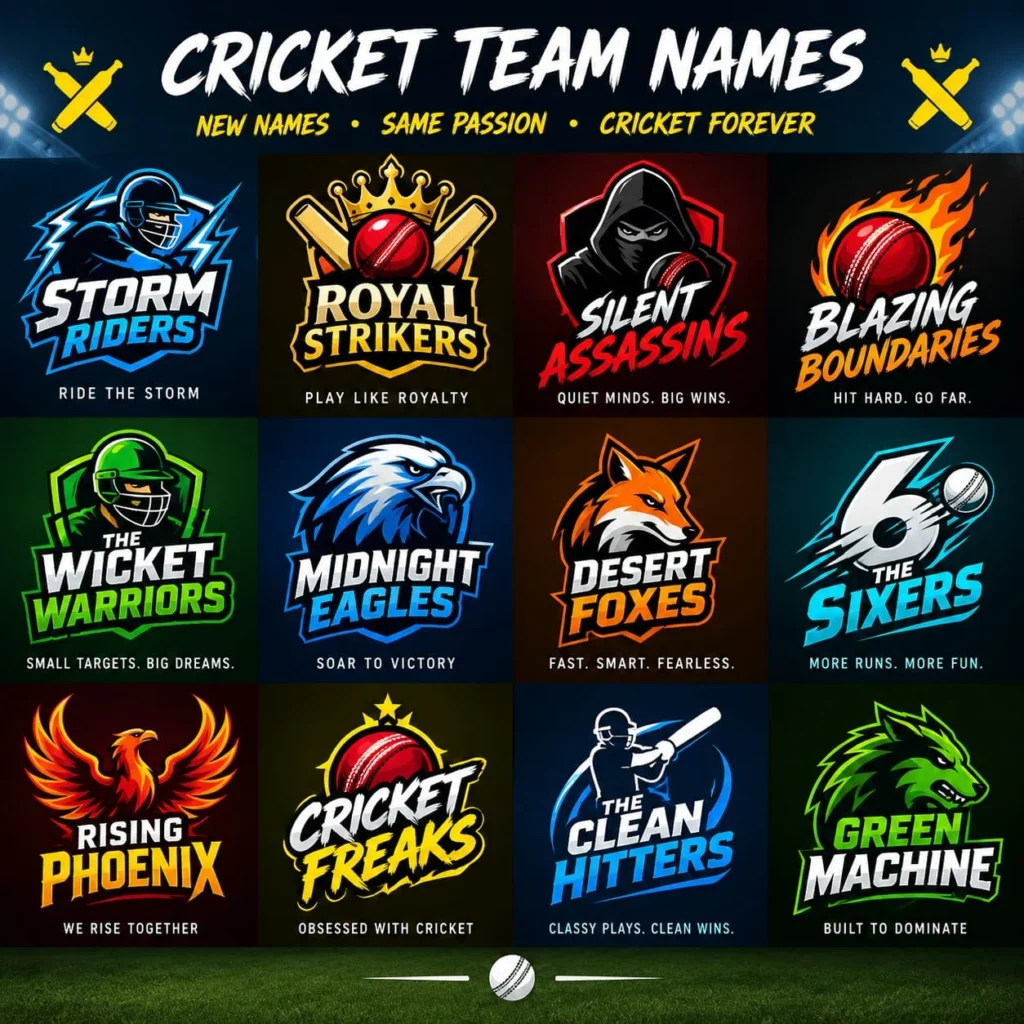
New names for a cricket team work best when they come from something real: your ground, your motto, your quirks, or cricket’s own odd vocabulary. Below are fresh ideas, plus lessons from how The Hundred’s teams got their names and from the wandering clubs that picked theirs over dinner.
Where “new” names actually come from
Two real cases show how names get made from scratch, and what can go wrong.
Case 1: The Hundred’s eight franchises
When the ECB created eight new teams, naming was contentious. According to Wisden, Surrey rejected four proposed names for the London-area team (London Fuse, London X, London Union, and London Rebels) because they wanted to keep The Oval’s identity in the branding, and a compromise name, Oval Greats, was reported before the final choice of Oval Invincibles. ESPN noted the ECB had also registered trademarks for alternatives, such as London Invincibles, and that the Northern Superchargers were originally planned as “Leeds Superchargers.”
The reaction to the names is a useful test case. The Cricketer’s humor column pointed out that several names had been used by other sports, including London Monarchs, London Knights, and London Broncos, and that a band was already called Southern Brave. It also joked about alternatives such as “Oval Reluctants.”
The Oval franchise has since been renamed again. Wikipedia lists it as MI London, formerly Oval Invincibles, a reminder that names change when owners change.
The lessons for a new club:
- Keep a name that signals your place or identity. Surrey’s resistance to a generic London name came down to this.
- Check whether the name is already in use by another team, band, club, or brand.
- Check trademarks if you plan on selling anything.
- Expect people to riff on it. If a name invites an easy joke, decide whether you’re fine with it.
Case 2: The wandering clubs
Wandering clubs have no home ground, and their names are some of cricket’s most inventive:
- I Zingari (1845) was named when a founder murmured “The Zingari, of course” at a dinner after a match, according to the club’s own history.
- Free Foresters (1856) took “Foresters” from the nearby Forests of Arden and Needwood, and “Free” because opponents were free to play against the club without needing permission. The club’s motto is the pun “United Though Untied.”
- Incogniti (1861) has the Latin motto “Incogniti Incognitis,” roughly “unknown only to the unknown.”
- Others of the era include the Quidnuncs (1851) and the Harlequins (1852).
Two ideas to borrow: start from a motto and let the name grow from it, as Free Foresters did, and use a single evocative word that signals a trait, like “unknown.”
Fresh names from cricket vocabulary
These use phrases that rarely appear on name lists:
- Cow Corner Collective
- Corridor of Uncertainty
- Rain Stopped Play
- Sticky Wickets
- Nervous Nineties
- Light Meter Heroes (for bad-light stoppages)
- Drinks Break Dynasty
- Tea Interval
- Follow-On Club
- Declaration Day
- Stumps Drawn
- Deep Square Dreamers
- Mid-Off Mavericks
Wandering-style names (for teams with no home ground)
- The Wayfarers
- The Itinerants
- Rambling Rovers
- Strollers XI
Franchise-style names for a new local league
Follow the place-plus-word pattern, but pick a place with real local meaning:
- Foundry Flyers
- Canal Comets
- Hilltop Harriers
- Orchard Owls
- Lighthouse Larks
- Millrace Marauders
Start with a motto
If you can’t land on a name, write a motto first. Free Foresters’ “United Though Untied” shows how a pun can carry the whole identity. Try one that fits your team:
- “Rain never stops us” → Rain Stopped Play
- “We always find the gap” → Gap Hunters
- “Last in, first to the bar” → Tail-End Tavern
Source comparison
| Source | Real example | Lesson | Name idea |
|---|---|---|---|
| Franchise creation | Oval Invincibles | Keep local identity, check trademarks | Canal Comets |
| Wandering club | Free Foresters | Build a name around a motto | Strollers XI |
| Latin tag | Incogniti | Signal one trait | One-word trait name |
| Cricket idiom | Corridor of Uncertainty | Familiar phrase, new use | Rain Stopped Play |
| Fielding position | Cow Corner | Specific and rare | Cow Corner Collective |
How to check that the name is really new
- Search it in quotes, including on social media and music platforms.
- Ask your league organizer for the current team list.
- Check whether another sport’s team uses it, as The Hundred’s critics did.
- Check trademarks if you plan on selling shirts or merchandise.
- Say it aloud and imagine the jokes people could make from it.
FAQ
What makes a name “new”?
It isn’t already in use by a local team, club, or band, and it isn’t a copy of a famous franchise. Using cricket idioms that rarely appear in lists is an easy way to get there.
Should the name include “CC”?
Many traditional clubs add CC for cricket club, which signals tradition. Teams in newer leagues often skip it.
Do we need a ground-based name?
No. The wandering clubs show that a name can work without a ground. If you do have a home ground, using it, as Surrey wanted to do with The Oval, adds identity.
Is a franchise-style name okay for a local team?
Yes, as long as it doesn’t copy a real franchise. Check that no other club in your area uses it.
What if members hate the name?
The Hundred’s names drew mixed reactions, and the teams survived. Test your shortlist with members and pick one nobody hates, since a name that’s tolerated by everyone is usually better than one that’s loved by half.
How long should the name be?
Two to four words is plenty. Shorter names work better on scoreboards and shirts.
Conclusion
The best new cricket team names come from something specific to your team, such as a motto, a ground, or a piece of cricket vocabulary, and survive a check against existing teams, bands, and trademarks. Borrow the wandering clubs’ habit of building from a motto, learn from The Hundred’s name battles, and skip historical names with offensive meanings. When in doubt, test the name by imagining how people could mock it.