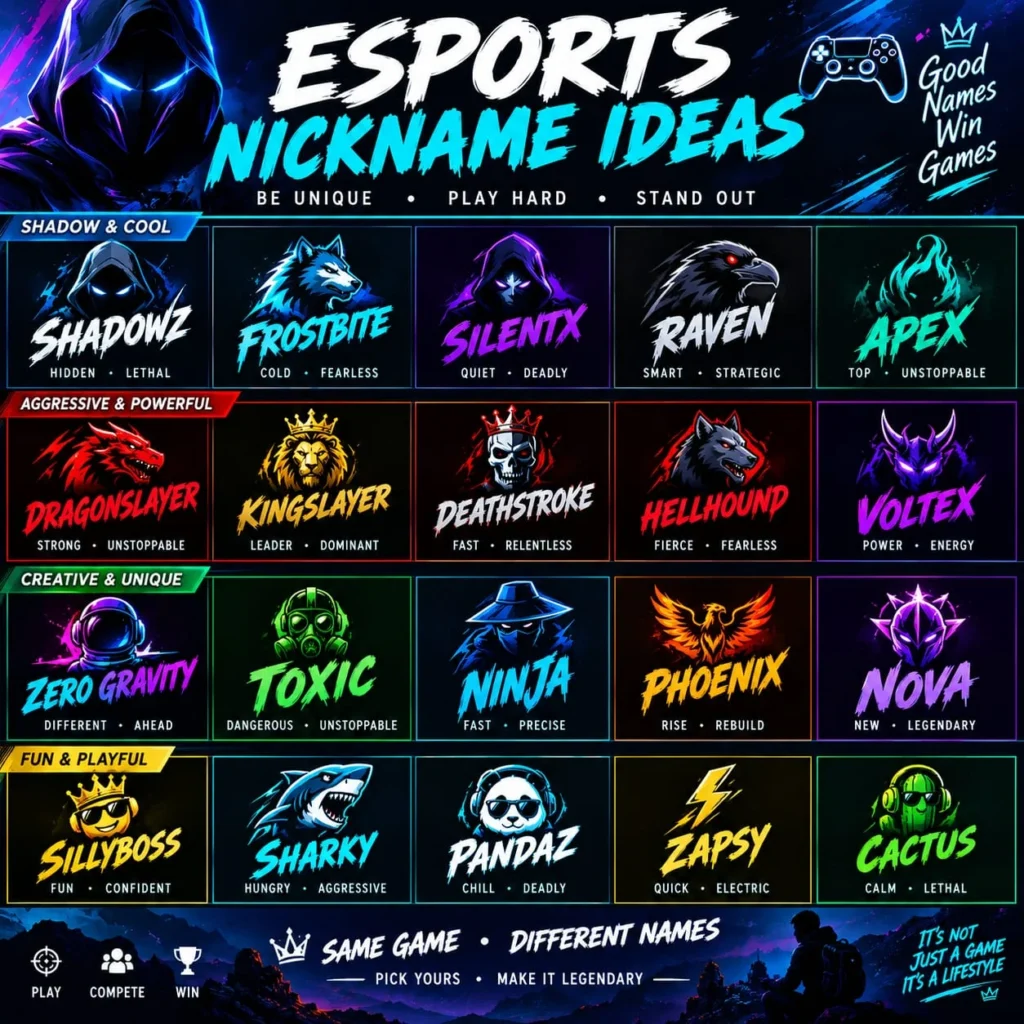
Esports Nickname: Meaning, Examples, Uses & Naming Tips
An esports nickname is the name a player uses as their competitive gaming identity instead of, or alongside, their real name. It is also commonly called a gaming handle, gamer name, in-game name, or gamertag, depending on the game or platform.
What Does “Esports Nickname” Mean?
“Esports nickname” is a plain descriptive phrase, not an acronym, abbreviation, or special piece of slang.
It normally means a player’s chosen name for competitive gaming. A player might use that name inside a game, in tournament registrations, on leaderboards, in broadcasts, or across gaming communities. Professional players can become so closely associated with their handles that fans and commentators use the nickname more often than the player’s legal name.
Examples include names such as Faker, s1mple, TenZ, Scump, and ZywOo. These are player handles rather than descriptions of the games themselves. Current esports discussions also routinely refer to professional players primarily by these names.
The phrase can also be used more broadly. Someone who is not a professional player may still call their competitive gaming handle an esports nickname when they participate in tournaments, ranked competition, or an esports community.
Esports nickname vs. ordinary nickname
An ordinary nickname is usually a name other people give you. An esports nickname is more often chosen and controlled by the player.
For example:
- Real name: Daniel
- Gaming handle: NightVex
- Team: Example Esports
- In conversation: “NightVex is playing tonight.”
That distinction matters because a gaming handle can become part of a player’s public identity and brand.
Esports Nickname vs. Gamertag vs. Username
These terms overlap, but they are not perfectly interchangeable.
| Term | Meaning | Tone | Popularity | Confusion Risk |
|---|---|---|---|---|
| Esports nickname | Competitive gaming identity or player handle | Competitive | Common in esports contexts | Low |
| Gamertag | A gaming identity used by a player, especially associated with online gaming services | Gaming | Very common | Medium |
| Gaming handle | A player’s chosen name or alias in gaming communities | Neutral | Common | Low |
| Username | An account identifier used to access or identify an online service | Technical/neutral | Extremely common | Medium |
| In-game name (IGN) | The name displayed for a player inside a particular game | Gaming | Common | Low |
| Real name | A person’s actual given/legal identity | Neutral | Universal | High when confused with a handle |
Microsoft used Gamertag as the name for Xbox Live’s player-identification system when the service was introduced; contemporary reporting described it as each player’s unique ID across the Xbox Live service.
That is why “gamertag” can sound more platform-specific than “esports nickname.” Meanwhile, username can describe an account name on almost any website or service, whether or not gaming is involved.
Where Are Esports Nicknames Used?
The phrase itself can appear in discussions about many gaming environments, but the actual nickname is usually tied to a particular game, tournament, team, or gaming account.
Competitive events can explicitly require players to register or maintain a nickname. For example, tournament rules have required a player’s nickname in the competition system to match the nickname used in the associated esports Discord server. Other esports rules have allowed players to use a nickname or pseudonym while requiring organizers to connect that identity to the registered competitor.
Esports broadcasts provide another important context. Research on esports broadcasting notes that players are commonly referred to by their in-game nicknames, sometimes making the handle the primary public identity viewers hear during a match.
Gaming handles can also extend beyond the game itself. Players and creators may use the same identity on social profiles, streaming services, community servers, and other online spaces, although the exact availability and naming rules differ from one service to another.
Where Did Esports Nicknames Come From?
There is no single documented moment when the “esports nickname” was invented.
The practice grew naturally out of online gaming and competitive gaming culture. Competitive video-game events existed decades before modern esports became an organized industry. One early recorded event took place at Stanford University in 1972, while arcade competitions and organized tournaments expanded during the 1980s and 1990s. The growth of home computers, internet connections, LAN competitions, and online multiplayer helped create the environment in which persistent player handles became especially useful.
The word esports itself is generally treated as a shortened form of electronic sports. Dictionary.com dates its first recorded use to the 1995–2000 period, while academic literature also describes esports/e-sports/eSports as forms or spellings of “electronic sports.”
The history of individual nicknames is much less standardized. Players have created names from shortened real names, favorite characters, jokes, words from games, personal experiences, random combinations, or completely invented terms. Some handles later become famous because of the player’s performance rather than because the original word had a special esports meaning.
That is an important distinction: an esports nickname does not have to mean anything in the dictionary to become memorable.
10 Example Conversations Using “Esports Nickname”
Because “esports nickname” is mainly a descriptive gaming term, it sounds most natural when discussing players, tournaments, or choosing a gaming identity.
1. Funny — Friends
A: “Bro, what did you put as your esports nickname?”
B: “PotatoAim.”
A: “You really named yourself that?”
B: “Yes. The name is honest. My aim is not.”
2. Playful — Gaming group chat
A: “I need a new esports nickname before the tournament.”
B: “Use something short.”
A: “Like what?”
B: “Anything better than your current name, ‘Player12345.’”
3. Sarcastic — Friends
A: “Rate my new esports nickname: HeadshotKing.”
B: “How many headshots did you get last match?”
A: “Two.”
B: “Then the name is definitely ambitious.”
4. Serious — Teammates
A: “We need everyone’s esports nickname for registration.”
B: “Should it match our Discord name?”
A: “Yes, so the organizers can identify everyone easily.”
B: “Got it. I’ll send the exact spelling.”
5. Funny — Family
A: “Mom, I changed my esports nickname.”
B: “Does this mean you changed your real name too?”
A: “No, Mom.”
B: “Good. I already learned how to spell the old one.”
6. Casual — Coworkers
A: “Do you play competitively?”
B: “Sometimes. My esports nickname is NovaRush.”
A: “Is that your real name?”
B: “Thankfully, no.”
7. Playful — Dating
A: “What’s your esports nickname?”
B: “ShadowFox.”
A: “That sounds very serious.”
B: “The name is serious. My gameplay isn’t.”
8. Serious — Tournament chat
A: “Please confirm your esports nickname before the bracket is published.”
B: “Confirmed: VexOne.”
A: “Same spelling as your registration?”
B: “Yes, exactly.”
9. Sarcastic — Gaming friends
A: “I’m choosing an esports nickname that scares opponents.”
B: “What’s your idea?”
A: “Uninstall.”
B: “That doesn’t scare them. It gives them instructions.”
10. Playful — Team group
A: “Everyone needs a nickname for the new roster.”
B: “Can I keep mine?”
A: “What is it?”
B: “KeyboardWarrior.”
A: “Unfortunately, that one fits too well.”
How to Reply When Someone Talks About an Esports Nickname
Funny
“Make it something your teammates can pronounce before the match ends.”
Serious
“Choose something distinctive, easy to read, and suitable for tournament use.”
Neutral
“An esports nickname is basically your competitive gaming handle. Gamertag and gaming handle are also commonly used for similar identities.”
A flirty response category is not especially natural for this term because “esports nickname” describes a gaming identity rather than a relationship or emotional expression.
Common Misunderstandings
One common mistake is assuming that “esports nickname” means a nickname for an esports team.
Usually, it means the individual player’s name. A team has its own team name, while each player can have a separate esports nickname.
For example:
- Team: Example Esports
- Player: ShadowVex
- Player’s real name: Alex Smith
Another misunderstanding is treating “esports nickname” as a formal technical term with one universal naming rule. There isn’t one. Different games, tournament organizers, teams, and platforms can impose different requirements.
A tournament might require a particular registered nickname, while a social platform might allow a different display name. Tournament documentation demonstrates that nickname consistency can sometimes matter for player identification and administration.
Who Uses Esports Nicknames?
The phrase can apply to professional esports players, amateur competitors, tournament participants, streamers, and ordinary gamers who participate in competitive communities.
There is no reliable basis for saying that esports nicknames belong exclusively to Gen Z or to one age group. Gaming handles developed across multiple generations as online multiplayer gaming expanded.
The distinction between generations is more useful when discussing familiarity with particular platform terms. Someone who grew up with Xbox Live may naturally say gamertag, while another gamer may prefer username, IGN, or handle. That reflects platform and gaming culture more than a strict age-based rule.
Regional differences also exist in gaming terminology, but the core idea is broadly international. Esports developed through interconnected gaming communities across North America, Europe, and Asia, with major competitive scenes emerging around different games and tournament systems.
Is “Esports Nickname” Rude or Safe?
Yes, the phrase itself is neutral and safe.
There is nothing inherently offensive, profane, or insulting about saying “esports nickname.” It is appropriate in ordinary conversation, gaming communities, tournament discussions, and most school or workplace contexts.
The potential problem comes from the nickname itself, not the phrase.
A player might choose a handle containing profanity, sexual references, hate speech, harassment, or an offensive imitation of another person or organization. Such a name may violate a tournament’s rules or a platform’s community standards.
For a public esports identity, a clean and pronounceable name can also make practical sense because commentators, teammates, opponents, and viewers may all need to say or read it quickly.
What Makes a Good Esports Nickname?
The strongest practical insight from current gaming-name guides is that a nickname should be more than a collection of random symbols. Search results consistently emphasize memorability, readability, uniqueness, and suitability for the intended game or community.
A particularly useful test is the caster test:
Can another person read your name once and say it correctly?
That matters more in competitive gaming than it might seem. If a commentator cannot pronounce your handle, teammates repeatedly mistype it, or viewers cannot remember it after a match, the name loses some of its practical value.
Another useful test is the longevity test. A name based entirely on a temporary meme may feel clever today but become awkward later. A simple invented word, short combination, or meaningful personal reference may survive changes in games and teams better.
Decorative Unicode symbols deserve caution too. Some games and services accept particular characters while others reject them, display them incorrectly, or impose character restrictions. Current gaming-name resources explicitly warn that symbol support varies by game and platform.
FAQ
1. Is an esports nickname the same as a username?
Not exactly. A username is a general online account identifier, while an esports nickname specifically describes a gaming identity associated with competitive play. The same name can sometimes function as both.
2. What is another word for an esports nickname?
Common alternatives include gaming handle, gamer name, gamertag, IGN, in-game name, and player alias. The best term depends on the platform and context. “Gamertag” has a particularly strong association with Xbox, while “IGN” is common in gaming discussions.
3. Does an esports nickname have to be unique?
Usually, uniqueness is useful, but the exact requirement depends on the game or competition. A tournament may require a specific registered name or prevent duplicate names within its system. Checking the current competition rules is safer than assuming every platform follows the same rule.
4. Can my real name be my esports nickname?
Yes, if the relevant game or competition permits it. Some players use variations of their real names, while others use completely separate aliases. A pseudonym can also provide separation between a gaming identity and a person’s offline identity.
5. Why do professional esports players use nicknames?
A handle gives a player a consistent identity inside the competitive environment. It can appear on scoreboards, broadcasts, tournament records, team materials, and online communities. Over time, the handle may become closely associated with the player’s competitive career.
6. What is IGN?
IGN commonly means in-game name. It refers to the name by which a player appears inside a particular game. It can be the same as an esports nickname, but the terms are not necessarily identical.
7. Should an esports nickname use numbers or symbols?
It can, but readability should come first. Numbers and symbols may help distinguish a name that is already taken, while excessive decoration can make a handle harder to remember or pronounce. Compatibility also varies between games and platforms.
8. Can an esports nickname become a real-world brand?
Yes. A successful gaming handle can extend beyond the game into streaming, social media, merchandise, team branding, and other public activities. ESPN has documented examples of gaming handles being used across multiple social platforms and becoming part of a player’s broader public identity.
Conclusion
“Esports nickname” means a player’s chosen competitive gaming name or alias. It is a descriptive phrase, not an acronym or special slang expression.
The closest related terms are gamertag, gaming handle, username, and IGN, but each has a slightly different emphasis. The biggest practical difference is that an esports nickname is closely connected with a player’s competitive identity.
If you’re choosing one, prioritize clear spelling, easy pronunciation, memorability, and long-term usefulness over a complicated collection of symbols. And if you’re joining a tournament, check its current naming rules before assuming your preferred handle will be accepted.